
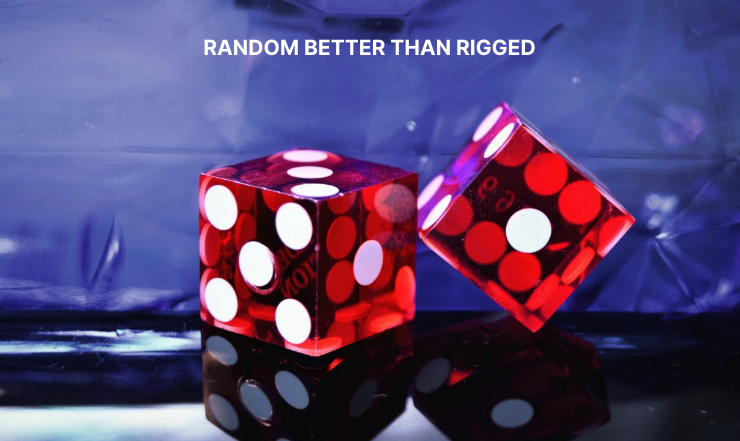
We can simulate dice throwing with Numpy and Python on this short code snippet
import numpy as np
import seaborn as sns
import matplotlib.pyplot as plt

### Simulate 6 side dices
dice = np.array([i for i in range(1, 7)])
dice

### Random select 1 element of the array
### np.random.choice could be a loaded dice
choice = np.random.choice(dice)
choice

### Simulate Rolling the dice  10000 times
n = 10000
rolls = np.array([np.random.choice(dice) for d in range(n)])
rolls

### Compute stats of rolls
m = np.mean(rolls)
v = np.var(rolls)

print(f"Mean is {m} and Variance is {v}")

### Histogram of Dice throw
n_rolls_hist = sns.histplot(rolls, discrete=True)
n_rolls_hist.set(title=f"Histogram of {n} rolls")
plt.show()
Dice throwing is used as an analogy in quantum mechanics to explain probabilistic concepts, particularly the idea that a particle's state is not determined until measured, much like the outcome of a die roll is unknown until it stops.
Semiconductor engineers also often have to simulate the charge state of nanometer chip component like a dice throwing simulation. They only can know probabilistically what the charge could be for these tiny components just like we only can know when throwing a 6 side dices, we will observe or measure the result as number 6 for 16.67% of time.